 |
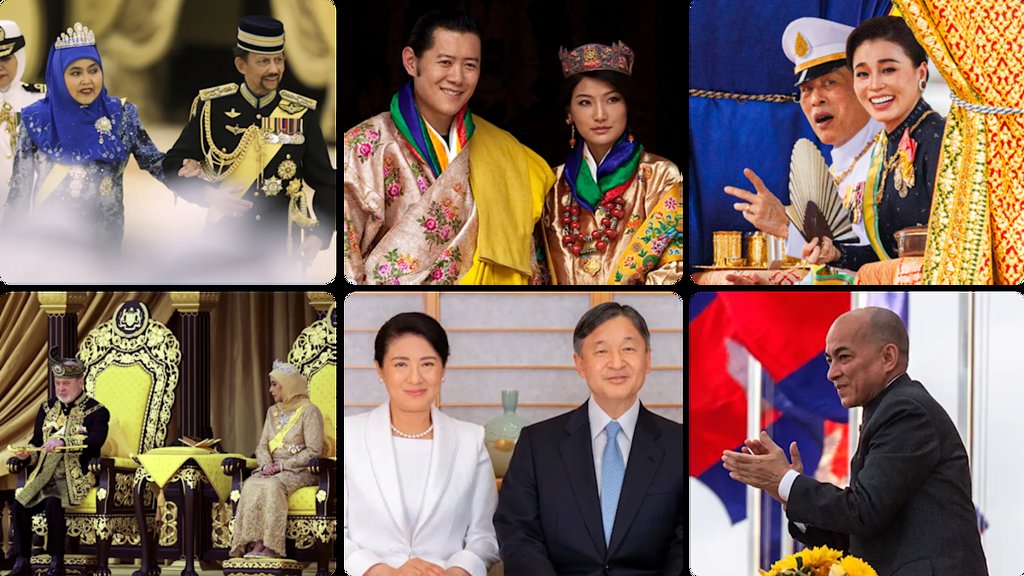 The royal families of Britain, Denmark, Norway, Spain and Sweden are among the monarchies most known to Australians, thanks to the interesting principals that make up their respective houses.
But look a little closer and there are six monarchies in Asia that are just as interesting and, perhaps, a little more colourful.
The monarchies of Thailand, Japan, Malaysia, Brunei, Bhutan and Cambodia have one thing in common: they are ruled by men. Graphic/Polly Hanning
Some have been in the headlines recently for various reasons: a cancer diagnosis, a death and the removal of a princess’ royal titles.
Meet the monarchies of Asia − Thailand, Japan, Malaysia, Brunei, Bhutan and Cambodia − who all have one thing in common: they are ruled by men.
Thailand
Thailand’s current monarch is Vajiralongkorn, which means “adorned with jewels or thunderbolts” − though he is better known as King Rama X.
The 74-year-old is part of the Chakri Dynasty and acceded the throne in late 2016 following the death of his father.
His coronation was held three years later, in 2019.
Early into his reign, King Rama X assumed full control over the royal assets, making him the world’s wealthiest reigning monarch, with an estimated net worth of approximately $43 billion.
Before his ascension, Vajiralongkorn married a Thai Airways flight attendant who is now known as Queen Suthida.
Thailand’s King Rama X and his wife Queen Suthida, pictured in 2024. Getty Images
Criticism of Thailand’s monarch is a criminal offence, illegal under the country’s lèse-majesté law, which carries heavy fines and mandatory jail sentences.
King Rama has seven children from four marriages, but he has not named an official heir.
In June, the death of the king’s eldest child Princess Bajrakitiyabha renewed concerns about a legitimate successor to the throne.
Bajrakitiyabha had been in a coma since 2022 when she collapsed while walking her dogs and became known as Thailand’s “sleeping princess”. While women have never sat on the throne in Thailand, it is technically possible under the constitution.
The Thai King and Queen pictured with Denmark’s King Frederik and Queen Mary in Sweden for the 80th birthday celebrations of King Carl XVI Gustaf in April. Michael Campanella/Getty Images
Before her collapse, Bajrakitiyabha was considered the frontrunner to succeed her father after years of high-profile roles, both in Thailand and abroad.
The other potential successors are Prince Dipangkorn, the king’s youngest child, and Vacharaesorn Vivacharawongse, the king’s second-eldest son.
Dipangkorn has long been rumoured to be on the autism spectrum or be neurologically disabled, putting him in doubt. Meanwhile, Vivacharawongse is married to an American woman which, according to the constitution, bars him from sitting on the throne.
King Rama’s daughter Princess Bajrakitiyabha collapsed in 2022 and was in a coma until her death in June 2026. She became known as Thailand’s “sleeping princess”. REUTERS
Vivacharawongse is one of the four sons King Rama had with his second wife, a former actress who he divorced in 1996. She moved to the US with her children, and while their youngest daughter was later accepted by the royal family and given the title of princess, her brothers remain estranged.
Last week, one of them made an emotional appeal to the king to return to Thailand for life-saving brain surgery from where he is being treated in Malaysia.
Thailand’s King Rama X also has a special link to Australia.
In 1970, as crown prince, he moved to Sydney to finish high school and was a student at the prestigious The King’s School in Parramatta.
Two years later he attended the Royal Military College in Canberra, which included training by the Australian Army and a bachelor’s degree at the University of New South Wales.
In 1975, he joined the Special Air Service Regiment in Perth before returning to Thailand the following year.
Thailand’s King Rama X, while crown prince, was a student at The King’s School in Parramatta in the late 1970s. The King's School Archives
By his own admission, he struggled to keep up at school and blamed his pampered upbringing in the royal palace.
Japan
Japan’s Imperial family has mythological origins dating back more than two millennia.
Known as the Chrysanthemum throne, Japan’s royals are part of the world’s oldest hereditary monarchy.
Japan’s Emperor Naruhito and his wife Empress Masako with their daughter Princess Aiko, pictured in 2021. The princess, who is the emperor’s only child, is not eligible to ascend the throne. AP
Emperor Naruhito ascended the Chrysanthemum throne on May 1, 2019, following the abdication of his father. Emperor Akihito became the first Japanese emperor in more than 200 years to abdicate, bringing the Heisei imperial era to an end.
Emperor Naruhito is 66. First in line to the throne is Crown Prince Fumihito, 60, the emperor’s younger brother.  His son, Prince Hisahito, 19, is second in line.
Third in line for the throne, and the last eligible candidate for the top job, is the emperor’s 90-year-old uncle, Prince Hitachi.
Japan’s government is in the process of changing the Imperial House law, aiming to solidify the principle of the imperial bloodline, but it pushes aside the emperor’s daughter leading to criticisms the law is anachronistic and sexist.
Naruhito became emperor of Japan in 2019 when his father Emperor Akihito abdicated, becoming the first Japanese emperor in more than 200 years to do so. EPA/AAP
Princess Aiko, 24, is the only child of Emperor Naruhito. She is hugely popular with many Japanese wanting her to be his successor but, as a woman, she is ineligible.
The revision would allow princesses to keep their status and perform royal duties if they marry a commoner, but their husbands and children would remain non-royals.
Another change would allow unmarried male descendants aged 15 or older of very distant imperial male relatives to be adopted into the immediate royal family to father heirs. Only those of paternal lineage can be chosen for adoption.
In 2024, Japan’s emperor and empress made a state visit to the UK, where they were the guests of a banquet inside Buckingham Palace. Getty
The Imperial Palace is home to the family and is located in central Tokyo on the former site of Edo Castle, which used to be the seat of the Tokugawa shogun who ruled Japan from 1603 until 1867.
The current palace dates from 1888, but it was destroyed during World War Two and later rebuilt.
Malaysia
Malaysia has one of the world’s most unique forms of monarchy, as it is a rotating system that sees the royal family change every five years.
Its current ruler is King Sultan Ibrahim Iskandar. He was sworn in on January 31, 2024, followed by a coronation six months later at the Royal Palace, making him Malaysia’s 17th king.
Sultan Ibrahim Iskandar, pictured with his wife Queen Raja Zarith Sofiah, was crowned in July 2024, becoming the 17th king of Malaysia under the country’s rotating system of monarchy. AP
Malaysia’s rotating monarchy began when the country gained independence from Britain in 1957. Under the system, nine ethnic Malay state rulers take turns as Malaysia’s king for five-year terms.
Although Malaysia has 13 states, just nine of them have royal families, some which trace their roots to centuries-old Malay kingdoms that were independent states until they were brought together under British rule.
Of Malaysia’s nine states with royal families, seven of them − Kedah, Kelantan, Johor, Perlis, Pahang, Selangor and Terengganu − are hereditary monarchies.
In the state of Perak, the crown is rotated between three branches of the royal family. The state of Negeri Sembilan has an elective monarchy, which sees a ruler chosen from male members.
The coronation took place inside the National Palace in Kuala Lumpur. AP
Sultan Ibrahim is from Malaysia’s southern state of Johor, which borders Singapore, and he is married to Queen Raja Zarith Sofiah.
He is unusual among the other royal families as Sultan Ibrahim is the only ruler with a small, private army. Johor was allowed to keep its army when it joined modern-day Malaysia.
Sultan Ibrahim is regarded as one of Malaysia’s richest men and has a business empire spanning telecommunications to real estate.  He is also famous for collection of luxury cars and motorbikes.
The king’s title is Yang Di-Pertuan Agong, which means He Who is Made Lord, and he plays a largely ceremonial role. The sultan is regarded as the protector of Islam and Malay tradition. Administrative power in Malaysia lays with the prime minister and parliament.
However, laws, cabinet appointments and the dissolution of parliament for general elections require his formal assent. The sultan also has the power to proclaim an emergency and pardon criminals.
The order of rotation among the sultans was originally determined by seniority, based on how long they had been ruling. That rule was dropped after all the royal families completed a term each, and they now take turns based on the initial order.
Brunei
In early August, the small but wealthy kingdom of Brunei made headlines around the world when its sultan stripped his daughter-in-law of her royal titles for behaviour or actions “unbecoming of a spouse of a member of the royal family”.
The change affected the wife of Prince Abdul Malik Hassanal Bolkiah, who is the youngest son of the sultan to his first wife Queen Saleha. He is fourth-in-line to the throne.
The Sultan of Brunei holds the title of the world’s longest-reigning monarch and he has an estimated fortune of between $28-$45 billion. AP
No reason has been given for the removal of her princess title and HRH status, though there are rumours a divorce is imminent.
The former princess’ actions had “tarnished the monarchy’s good name and demonstrated a lack of respect towards Sultan Hassanal Bolkiah”, reports suggested.
Brunei is ruled by 80-year-old Hassanal Bolkiah, who holds the title of the world’s longest-reigning monarch. The Sultan of Brunei is one of the world’s wealthiest heads of state with an estimated fortune of between $28-$45 billion.
He ascended the throne in 1967. The sultan rules the absolute Islamic monarchy of Brunei − a small nation on the island of Borneo near Malaysia − which earns most of its wealth from oil and gas after gaining independence from the UK in 1984.
The 80-year-old sultan ascended the throne of Brunei in 1967. EPA/AAP
The heir to Brunei’s throne is Al-Muhtadee Billah ibni Hassanal Bolkiah, who is the world’s longest-serving heir to the throne.
He was formally proclaimed crown prince in 1998, and is next in line to become the 30th Sultan of Brunei. Before him, King Charles III of Britain held the title of the longest-waiting heir apparent.
One of the most popular members of Brunei’s royal family is Prince Abdul Mateen, who is fifth-in-line to the throne.
Prince Abdul Mateen, who is fifth in line to the throne, is one of Brunei’s most popular figures. In February he and his wife, Princess Anisha, welcomed a daughter. Instagram/@tmski
Despite being the second last of his father’s children, Abdul Mateen is the one seen most often by the sultan’s side at major events around the world, including royal and political occasions.
In February, Prince Mateen and his wife Princess Anisha welcomed their first child, a daughter. However, Princess Zahra Mariam Bolkiah is ineligible to join the line of succession as females are barred from ascending the throne in Brunei.
Bhutan
Bhutan is ruled by King Jigme Khesar Namgyel Wangchuck, who is married to Queen Jetsun Pema.
The Bhutanese name for Bhutan, Druk Yul, means ‘Land of the Thunder Dragon’.  The king is often referred to as the ‘Dragon King’ and his wife the ‘Dragon Queen’.
King Jigme Khesar Namgyal Wangchuck and Queen Jetsun Pema are often referred to as Bhutan’s ‘Dragon King’ and ‘Dragon Queen’. AP/AAP
Their eldest son is Prince Jigme Namgyel Wangchuck, 10, who is heir to the Kingdom of Bhutan − a tiny Himalayan landlocked country that shares borders with China and India.
For much of the 20th century, Bhutan was isolated from the world, preserving much of its Buddhist traditions, landscape and wildlife.
King Jigme came to the throne in November 2008, following the abdication of his father in December 2006.
The former king began the transition of Bhutan from an absolute monarchy to a democratic constitutional monarchy in 2008. King Jigme is the fifth in a line of hereditary rulers who have reigned in Bhutan for the last 100 years.
He made headlines for marrying a commoner, the now Queen Jetsun, in October 2011. She made history by becoming the world’s youngest queen consort, aged just 21 when she married Bhutan’s ruler.
In October 2024, the king and queen - and their three children - visited Canberra as part of a short, but widely popular, tour of Australia. @kingjigmekhesar
They have three children: Prince Jigme Namgyel Wangchuck, Prince Ugyen Wangchuck and Princess Sonam.
The royal children are well known in Bhutan and regularly attend official engagements, and religious ceremonies, with their parents.
Cambodia
King Norodom Sihamoni, 73, is Cambodia’s head of state and constitutional monarch.
The king has kept a relatively low profile since he ascended the throne in October 2004, one week after the abdication of his father, King Norodom Sihanouk.
In April the king’s office, and Cambodia’s state news agency AKP, announced the king had been diagnosed with prostate cancer.
The King of Cambodia, Norodom Sihamoni, was best known as a ballet dancer before he was named monarch. In April he was diagnosed with prostate cancer. Omar Havana/Getty Images
He was diagnosed with the condition in China where he and his mother, Norodom Monineath Sihanouk, travel to for regular health check-ups.
On Thursday this week, King Sihamoni returned to from Beijing where he is receiving treatment.
Sihamoni’s father, who also received care in China, was diagnosed with prostate cancer in 1993, but lived until 2012, when he died at age 89 in Beijing.
The king’s role in Cambodia is largely a ceremonial one.
Before becoming king, Sihamoni served as Cambodian Ambassador to the U.N. cultural agency UNESCO, and was best known as a classical ballet dancer. He is unmarried and has no children.
Sihamoni spent much of his childhood outside of Cambodia during the country’s Indochina wars but returned with his parents during the totalitarian Khmer Rouge regime under Pol Pot. Several of his half-siblings were killed during that period and Sihamoni was later evacuated to China, before setting in Paris where he became a professor of classical dance.
He was selected as Cambodia’s next king over one of his higher-profile siblings or uncles, reportedly due to his father’s desire that someone neutral and politically untainted succeed him.
Sihamoni was initially reluctant to become monarch but later accepted the role after a unanimous vote of approval by Cambodia’s nine-member Throne Council.
. |


