|
 7 min read
It’s a misty, wet day in March on Vancouver Island, and I’m stepping onto the set of Yaga, a spooky new mystery drama from Canadian streaming service Crave, premiering stateside on AMC+ on October 23. Toronto-based playwright Kat Sandler adapted the series from her 2019 play of the same name and serves as its showrunner. In this westernmost slice of Canada, it rarely snows during winter.
Instead, there is a constant deluge of rain, and fog rolls over the island’s coast to fill its lush green forests with an eerie quality. You could easily imagine a witch living in these woods, crushing bones to dust and cackling into the night. It is the perfect backdrop for Yaga, arriving on our screens during the year’s spookiest month.
Yaga begins as a missing-person investigation that will feel familiar to fans of the mystery genre: Carson (Clark Backo) is a local detective investigating the disappearance of Henry (Hudson Williams), a college student who happens to be the heir of a commercial fishery. His wealthy parents, hoping to take matters into their own hands, hire Rapp (Noah Reid), a private investigator whom Carson reluctantly agrees to work with. Together, they interview people in the small coastal town of Whittock to collect evidence into Henry’s disappearance—but there is something deeply amiss, from Henry’s secretive osteology professor, Katherine (Carrie-Anne Moss), to the odd, witchy phenomena that begin to plague Rapp as he gets deeper into the case. Woven into the investigation is the legend of Baba Yaga, a powerful witch from Slavic folklore who can help or harm those who cross her path. Whether she lurks in the woods or walks among the townspeople is part of the mystery.
Crave / Christopher Lawrence
Today, the production and all-Canadian cast have set up shop at St. Michaels University School, a fancy boarding school on the southern tip of the island, a short drive from Victoria. I’m in the producer’s tent, damp and shivering under a blanket with a headset on, watching Reid and Backo descend the steps outside the school’s central entrance for yet another take of a scene from the second episode. The bricked exterior is covered almost completely with vines, and Moss is looking down through a window on the top floor. I watch Reid, in character as Rapp, try a few variations on a greasy wink directed at Katherine as the take wraps. Backo groans at his cockiness, establishing their entertaining, perhaps flirtatious rapport.
“I can’t fucking believe I get to do this,” Sandler tells me later, tucked away in the corner of a student lounge, with a twinkle of passion in her eyes. “We don’t get to do stuff like this in Canada that takes risks, that pushes the envelope and is willing to not sit in comfort. Heated Rivalry did it.” Despite Yaga’s original form as a play, Sandler says it feels only natural for it to have ended up as television.  In fact, she has always felt she was “stealing” from television in her writing. “The whole point was to try to make theater for people who don’t like theater—make it really fast-paced, funny, sexy, and violent,” she says. “My dialogue has always been really cinematic and very TV-esque.”
Crave / Christopher Lawrence
The series offers a modern feminist retelling of that folklore. Both the play and series open with a monologue by the voice of Yaga herself, listing the many different interpretations of the witch over the years that have formed an uncertain mythology around the character. As the stories go, she could be old and ugly, living in a hut in the woods, flying around in a mortar and pestle. Does she grind the bones of children, or is she a feminist icon to be reclaimed from these stories? Is she inherently evil, or is there more nuance to explore? Yaga is seeking to tell a new story.
“We’re re-envisioning what the wicked old witch could be,” Sandler says. “How the perspective of an older, powerful sexual woman might change the stories that have been told, and how that intersects with post–Me Too and the horrible bad dogs that we’re dealing with on a global scale now, and what it is to be an enabler and not just an abuser or a bad person.”
Crave / Christopher Lawrence
Sandler also tells me the show is as spooky as it is horny, and based on the first two episodes I saw premiere at the Toronto International Film Festival—including a scene in which Hudson Williams wears nothing but overalls—I can confirm as much. “I want it to be horny for all. That’s the headline,” Sandler says as we share a laugh. “This show is all about feminism and storytelling and female power and rage and sex and how those things intersect.”
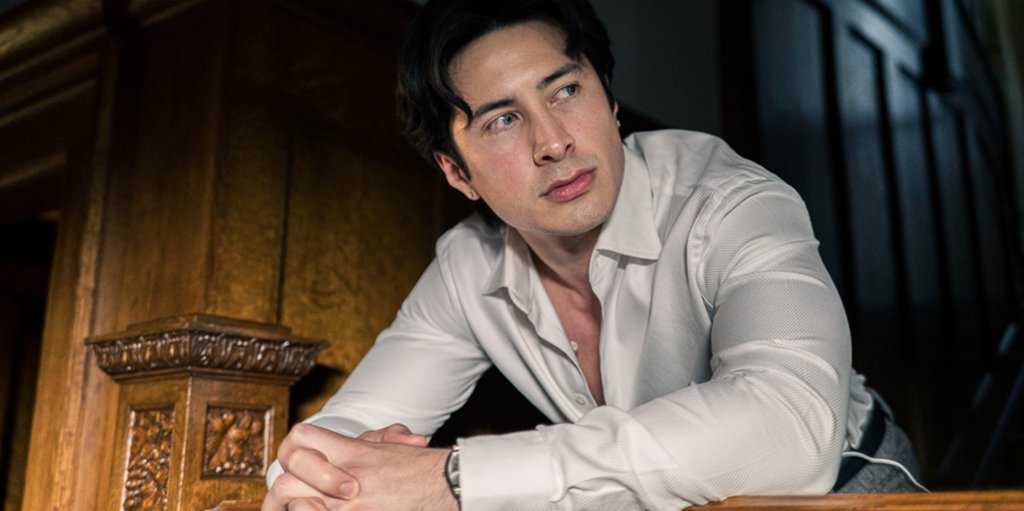
Williams had wrapped his scenes before I arrived on set, but it’s been clear how his Heated Rivalry star power has shined a light on Yaga; physical copies of the play sold out instantly after his casting was announced. Sandler says Williams, who was cast after the rest of the actors, was “a surprise joy.” In the play, just three actors take on all the roles. It is quite the twist to see Williams play not one but two characters here, in something of an homage to those theater actors.
Crave / Christopher Lawrence
“We introduce this character of Logan, who is Henry’s roommate, who looks suspiciously a lot like Henry,” Sandler clarifies.   “Are they brothers?
Are they just weirdly look-alikes? We don’t know. That becomes one of the side quests.”
Williams shares quite a few scenes with Moss, who plays Henry’s professor with a special interest in bones. “He’s just a wonderful young man and actor,” Moss tells me. We’re seated in the main auditorium at the school, where the iconic Matrix and Jessica Jones actress is set to deliver a lecture about killer spiders for her role. It’s her second to last day on set as both actress and executive producer, and she tells me it’s been an unusual but thrilling experience to shoot so much so quickly: eight half-hour episodes in 32 days. Moss has had gray streaks added to her hair, and I immediately address the rumors around set that she’s witchy herself, passing out tinctures of peppermint oil to the crew and cast. “I'm very much into all of that,” she says.
Crave / Christopher Lawrence
When Moss received the script, she had been reading about the myth of Baba Yaga in the preceding weeks, in a bizarre coincidence. I ask Moss if she believes in signs, in the universe pushing her toward this project. “I pay attention because those things do happen if you pay attention,” she says. “I definitely took that as a bit of a message.” She also hadn’t been back in Victoria since she was a kid; it’s a city she came to every summer to spend time with her aunt—a formative experience and now a full-circle moment of return. As far as her character, Katherine, goes, it’s a darker role than Moss is used to, one that holds the viewer in ambiguity. Is she an innocent professor minding her business, a red herring, or Baba Yaga herself?
It’s up to the investigation of Rapp and Carson to answer that question, which forms the familiar piecemeal interrogation structure of the series that’s reminiscent of Mare of Easttown and True Detective. For Reid, this role has been long overdue. The Schitt’s Creek and The Vampire Lestat actor and musician had originally been set to star in the play when it first premiered in Toronto. A last-minute scheduling conflict forced him to withdraw. He wrote Sandler a heartfelt email at the time, promising he would make it up to her some day in the future. When the series was greenlit, she forwarded the email back to him to cash in on his promise. “I was really excited at the prospect of closing that loop,” Reid tells me.
Crave / Christopher Lawrence
Reid has been getting a kick out of playing the complexities of Rapp, especially as a fish-out-of-water PI who’s puffing his chest to compensate for the fact that he’s sometimes slightly out of his depth in this case. “There’s something inherently charming about him. He has no shame. He’s not totally genuine,” he says. “Anything that he’s doing well, he knows he’s doing it well, and anything he’s not doing well, he doesn’t know he’s not doing it well.”
Our conversation naturally turns to this moment for Canadian pop culture and whether or not he thought about pursuing a career in the U.S. after the success of Schitt’s Creek. He looks back on that time fondly, particularly in the weeks following the news of Catherine O’Hara’s death. “Can I do what I want from here? Because this is where I want to live,” he says. “It feels like our generation is pushing the boundaries. This kind of storytelling [on Yaga] is messier and dirtier and darker, and it’s a reflection of the world we live in.”
Crave / Christopher Lawrence
Backo, who you might recognize from Letterkenny or The Changeling, was drawn to Sandler’s “freaky writing.” “I appreciate so much the subversion of the stereotypical context of a woman being not believed and gaslit in a way I don’t think I’ve actually ever seen before. Carson is very layered.” To say more would be to give away the ending, but Backo does offer a sense that the series might not conclude in the way viewers expect.
As for Yaga’s future, Sandler cites The White Lotus as a model for how subsequent seasons could take shape, should the series be renewed. One thing is clear and echoed by cast and crew throughout my visit: This is a project born of passion and community, propelled by executive producer Mackenzie Donaldson’s determination to get it made and the bonds forged by a team who created so much in so little time. |


