|
 Colorado was well-represented at the 2026 Great American Beer Festival. The state took home dozens of medals, including a brewery of the year award, and boasted seven first-time winners.
“Colorado continues to showcase why we call ourselves The State of Craft Beer,” said Colorado Brewers Guild Executive Director Shawnee Adelson in a statement. “Congrats to all of the medal winners!”
In all, Colorado breweries and cideries took home 41 medals — 16 gold, 12 silver and 13 bronze. But as impressive as that is, it’s not the biggest news of the event.
With a move to an outdoor venue, along with all the changes in logistics and atmosphere that entailed, the newness of the festival itself overshadowed that of the individual accomplishments.
A 44-year festival refresh brings the good, the bad and the different
Sign up for the Food & Drink newsletter to get the latest stories delivered to your inbox
The state of Colorado craft beer in 2026
Spaghett-aboutit: Where to find the viral beer cocktail in Denver
Sneaky sips: Four hidden wine treasures in Denver
GABF 2026 was held at Levitt Pavillion.
Ryan Pachmayer for Westword
The festival itself could be summarized as “so many changes.” Being outside was the big and obvious one, but the festival had a number of other notable departures from years past. You didn’t have to go very far to hear folks talking about the changes, from the good, to the bad, to the simply different.
The Good: The venue provided attendees an experience in the gorgeous October Denver weather. The hillside venue allowed for plenty of great views of the surrounding city. Breweries doing the pouring (instead of servers) made it significantly easier to ask questions. And the larger pour sizes made it feel less like taking 100 shots of beer and more like a real beer festival again.
Smaller things, like letting folks in a little bit early each day, started the day off right. People may enjoy pointing to the heyday of the fest — when you had about four times the breweries present — but those days also included waiting in one-hour-plus lines just to get in late, only to hear an earlier and definitive last call. The new format is superior in that regard.
Quick Fixes: Bathroom logistics on day one were a major frustration. Putting all the portable toilets in one area, on the opposite side of the venue from where most folks were sampling, created a long wait. The U-shaped layout didn’t help, as many folks at the front of the line didn’t pay enough attention to know when there were vacancies. Having more options (both in volume and spacing, with a few more places around the venue) would’ve helped quite a bit. On day two, more were added, and it seemed to resolve most of the frustration.
Water stations were also oddly absent throughout the fest. Having some additional tent space, as well as seating, might help people relax and re-energize, especially given the warmer, sunnier weather.
One Major Challenge: Those are all fairly low-hanging fruit improvements for next year. If the venue remains the same, there is one more difficult, but serious challenge to overcome: accessibility. All day long, you could see the frustration from folks with mobility issues. The venue is set on a grassy hill, so inherently, this is not an easy thing to address.
That said, there are ways. One suggestion: empower the previous army of volunteers that the festival used to rely on to pour beers, and ask for volunteers to run an ADA tent towards the bottom of the hill, where the surface is flat. Volunteers can provide a delivery-style service to folks with mobility challenges, bringing them 2-4 ounce samples from breweries of their choice.
The Different: Transportation was a big pre-fest concern. Most folks we spoke to during or after the festival didn’t find it to be too difficult of a trip to figure out. Many simply parked up in the neighborhood at the top of the hill.  Unlike previous festivals, parking was free. Others took one of the many shuttles from local breweries, hotels, and the festival itself. Rideshares were also common, and the bicycle racks were jammed each day.
The awards were also a big departure from previous festivals. Open to all attendees, they shifted from an industry-only auditorium event to one that involved the entire festival. A few additional speakers towards the top of the hill and up into the Paired area would’ve completed that experience.
Grade: B-. Smoothing out the easy logistical snags (like bathrooms and water) would easily bump this up to a B+. However, figuring out how to make this hillside venue truly accessible for attendees with mobility issues is the mandatory hurdle to clear before the festival earns an A.
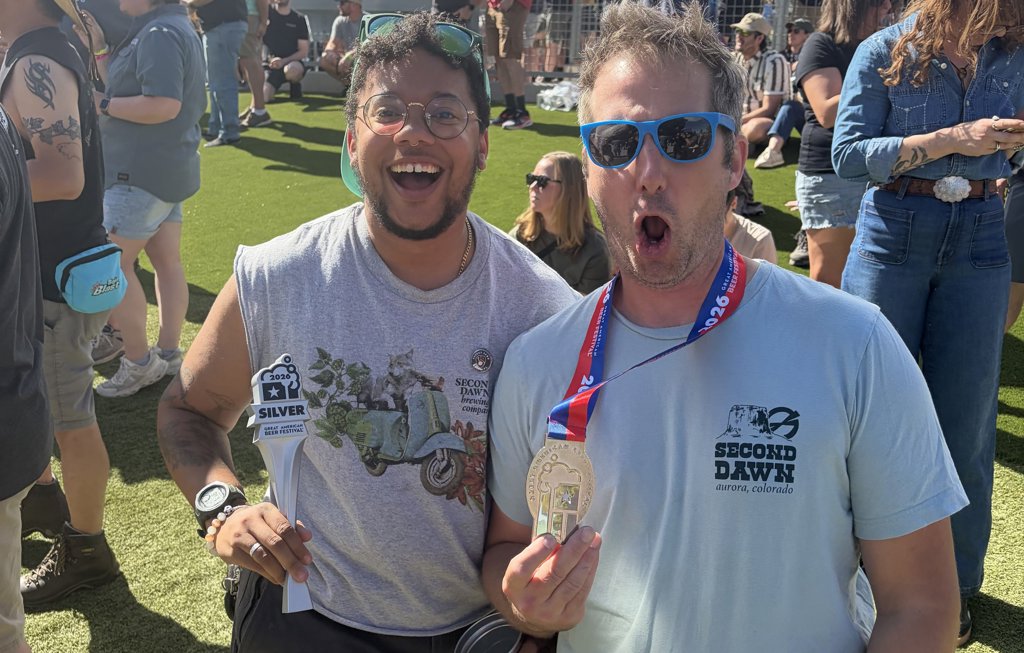
Colorado award winners at the GABFSecond Dawn brewmaster Ross Koenigs (right) celebrates with assistant brewer Austin Korgan (left).
Ryan Pachmayer for Westword
Moving on to the awards, there were several big-ticket items that stood out among Colorado winners.
Cannonball Creek Crushed It Again
Cannonball not only won three medals — pushing its streak to 14 consecutive years of winning a medal at GABF — but for the second year in a row, it won brewery of the year in the 501-1,000-barrel category. It has now won for its Featherweight Pale Ale six different times at the fest, and for its Trump Hands Session IPA four times.
This wasn’t the only competition that Cannonball placed at this weekend. Alpha King — a competition hosted by Yakima Chief Hops and 3 Floyd’s — moved to Westbound & Down’s downtown location. With over 160 West Coast-style IPAs entered, Cannonball was only one of four breweries that placed. Its Badankadank IPA won the coveted “Jesse’s Pick,” an award dedicated to a former Yakima Chief team member who embodied a higher-energy, rock n’ roll attitude.
Colorado Takes Gold in a New Category
Each year at competition, GABF tries to showcase emerging trends and products. This often results in categories with specific requirements: using a single, new, public hop variety. This year, it was the craft malt category where each beer had to use over 50% craft malt in its entry. Dostal Alley Brewpub & Casino in Central City won this category for its Jacob Mack Mild Ale.
Castle Rock Mexican Lager
Castle Rock’s Wild Blue Yonder Brewing took gold in the Mexican-Style Pale Lager category, while nearby 105 West took silver. It’s uncommon for two breweries in the same state to take gold and silver in the same category, let alone two different breweries from the same town. Perhaps a collaboration lager is in store for the near future.
Here is the full awards list, including an impressive showing for Colorado cideries, with Snow Capped Cider winning Cidermaker of the Year.
Gold Medals
Bent Barley Brewing Company – Dry Irish Stout (Porter or Stout)
Bierstadt Lagerhaus and Wayfinder Beer – Infinite Hotel (Collaboration)
Bull & Bush Brewery – Pineapple 3 Way (Belgian-Style Fruit Beer)
Cannonball Creek Brewing Co.   – Mindbender (American-Style Strong Pale Ale)
Dostal Alley Brewpub & Casino – Jacob Mack Mild Ale (Craft Malt Beer – new category)
The Empourium Brewing Company – Honey Panda (Specialty Beer)
Haykin Family Cider – Newtown Ice Cider (Experimental, Barrel-Aged or Specialty Cider)
Los Dos Potrillos Cervecería – Agua Fresca (American Fruit Beer)
The Sandlot Brewery at Coors Field – Calamansi Wheat (Fruit Wheat Beer)
Snow Capped Cider – Kingston Black 26 (Tannic Cider)
Snow Capped Cider – The Russets (No/Low Tannin Cider)
Sweet Heart Brands – Spiced Apple (Botanical or Spiced Cider)
Verboten Brewing and Barrel Project – Grow Old With You (Barley Wine or Wheat Wine)
The Well in Wellington – Altbier (Classic Gluten-Free Ale or Lager)
Wild Blue Yonder Brewing Co.
– Sereno Moreno (Mexican-Style Pale Lager)
Wild Blue Yonder Brewing Co. and Geoff Humphrey Castle Rock – The Burden of Being Wonderful (Pro-Am)
Silver Medals
105 West Brewing Co. – Mexican Lager (Mexican-Style Pale Lager)
Avery Brewing Co. – White Rascal (Belgian-Style Witbier)
Cannonball Creek Brewing Co. – Featherweight (American Pale Ale)
Glenwood Canyon Brewing Co. – Endless Groove (New Zealand-Style Pale Ale)
Haykin Family Cider – LUCY Ice Cider (Experimental, Barrel-Aged or Specialty Cider)
Liquid Mechanics Brewing Co. – Kolsch (German-Style Koelsch)
New Belgium Brewing Company – Trippel (Belgian-Style Tripel)
New Image Brewing Company and Offset Bier Co. – Neon Ladies (Collaboration)
Old 121 Brewhouse – Colt 121 (Other Strong Beer)
Second Dawn Brewing Company – Wolf of the Woods (Italian-Style Pilsner)
Snow Capped Cider – Harrison Reserve (No/Low Tannin Cider)
Verboten Brewing and Barrel Project – Coconut GO (Field Beer)
Bronze Medals
Cannonball Creek Brewing Co. – Trump Hands (Session India Pale Ale)
Holidaily Brewing Company – Fat Randy’s IPA (Hoppy Gluten-Free Beer)
Holidaily Brewing Company – Favorite Blonde Ale (Classic Gluten-Free Ale or Lager)
Liquid Mechanics Brewing Co. – El Poblano Borracho (Chili Beer)
Locavore Beer Works – Friend of the Devil (German-Style Schwarzbier)
MainStage Brewing Co. – Oktoberfestfest (German-Style Maerzen)
Pattern Break Brewing Co. – Negroni Ale (Experimental Beer)
Prost Brewing Company – Prost Helles (Munich-Style Helles)
River North Brewery – Quandary (Belgian-Style Strong Specialty Ale)
Ska Brewing – WestSKAlle (Belgian-Style Abbey Ale)
Snow Capped Cider – Pink Pearl (No/Low Tannin Cider)
Snow Capped Cider – Spiced (Botanical or Spiced Cider)
Tommyknocker Brewery & Pub – Jack Whacker Hazy Wheat (American Wheat Beer)
Upcoming Colorado Beer Festivals
If you love cheering on your favorite Colorado brewer, or are just looking for new award-winning beers to try, keep an eye out this winter for more winners. These competitions don’t have public festivals attached to them, but they are evaluated by seasoned judges.
The Denver International Beer Competition returns in November. Beers will be judged on November 7-8, with awards being announced soon after. The third annual Colorado Brewers Cup will also be back in late January, with the awards being announced on January 22. |


